The bottleneck is no longer the AI.
Agentic tools generate faster than I can read. The constraint stopped being output a while ago; now it is how much of it I can take in. And when the work reaches the part that is actually mine, weighing a tradeoff or naming a thing, nothing in the loop stops for it. Everything keeps moving and I sign off on thinking I never did.
Whose thinking is this step?
I ask that about every step. Where the model is better, it does the work. Where I am better, the question prints and the space under it stays blank. Moving that space onto paper matters more than it sounds. A sheet cannot suggest the next sentence while I am still working out what I think. When the page is full I photograph it and drop it back into the chat.
A pen has no autocomplete.
- 1The loop actually stops. Nothing runs ahead of the person.
- 2The model's part is set in type. The space under it stays blank.
- 3Where my handwriting contradicts the model, mine wins.
The model proposes in type. I decide in pen.
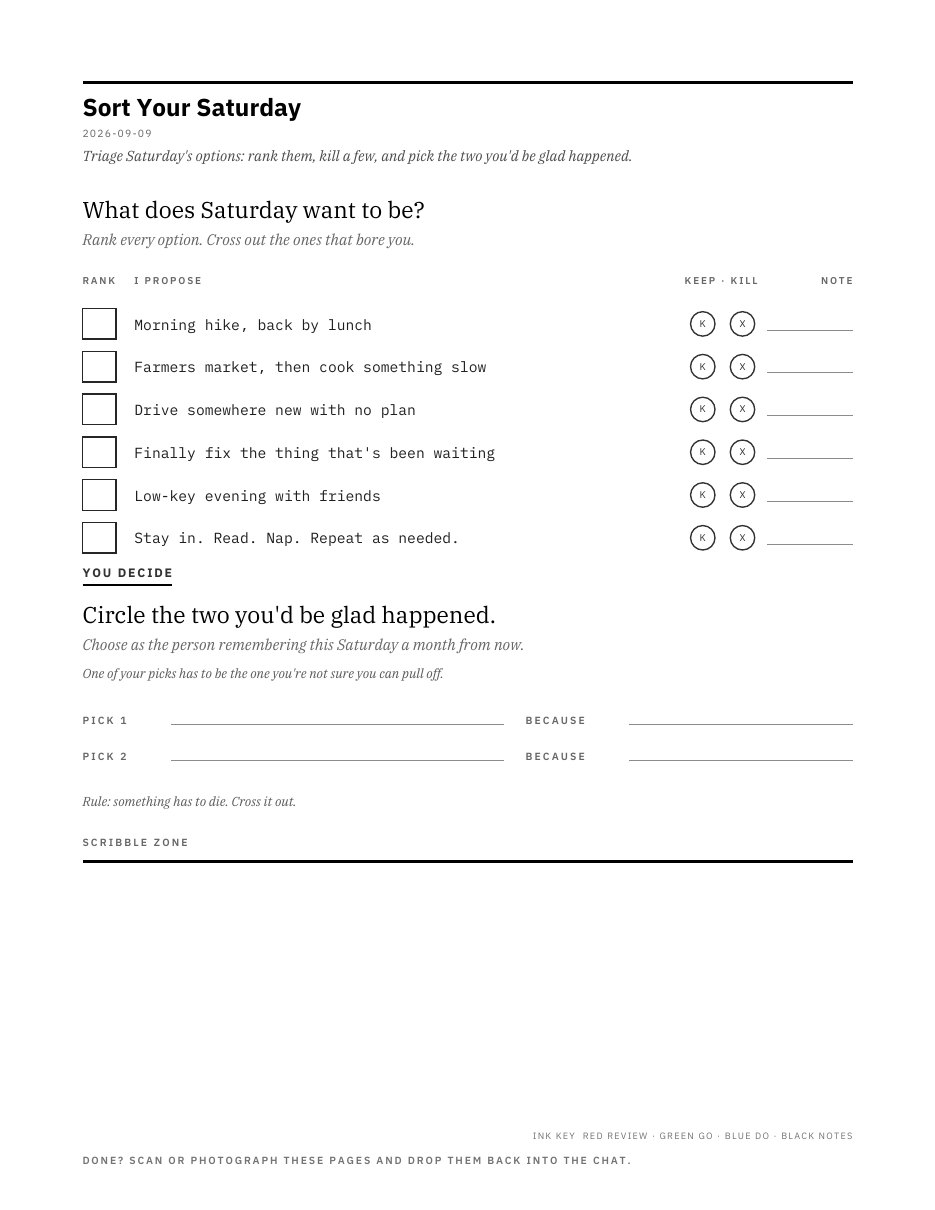
Sort Your Saturday is a whole session on one page.
 123
12301
Six options come from the model, set in mono so you can see who wrote them. Every rank box and every keep or kill circle beside them is blank.
02
Both picks are blank too, because that part is mine.
03
And the rule at the bottom is what makes the page work: something has to die, cross it out.
The obvious answers go first, so they stop taking up room.
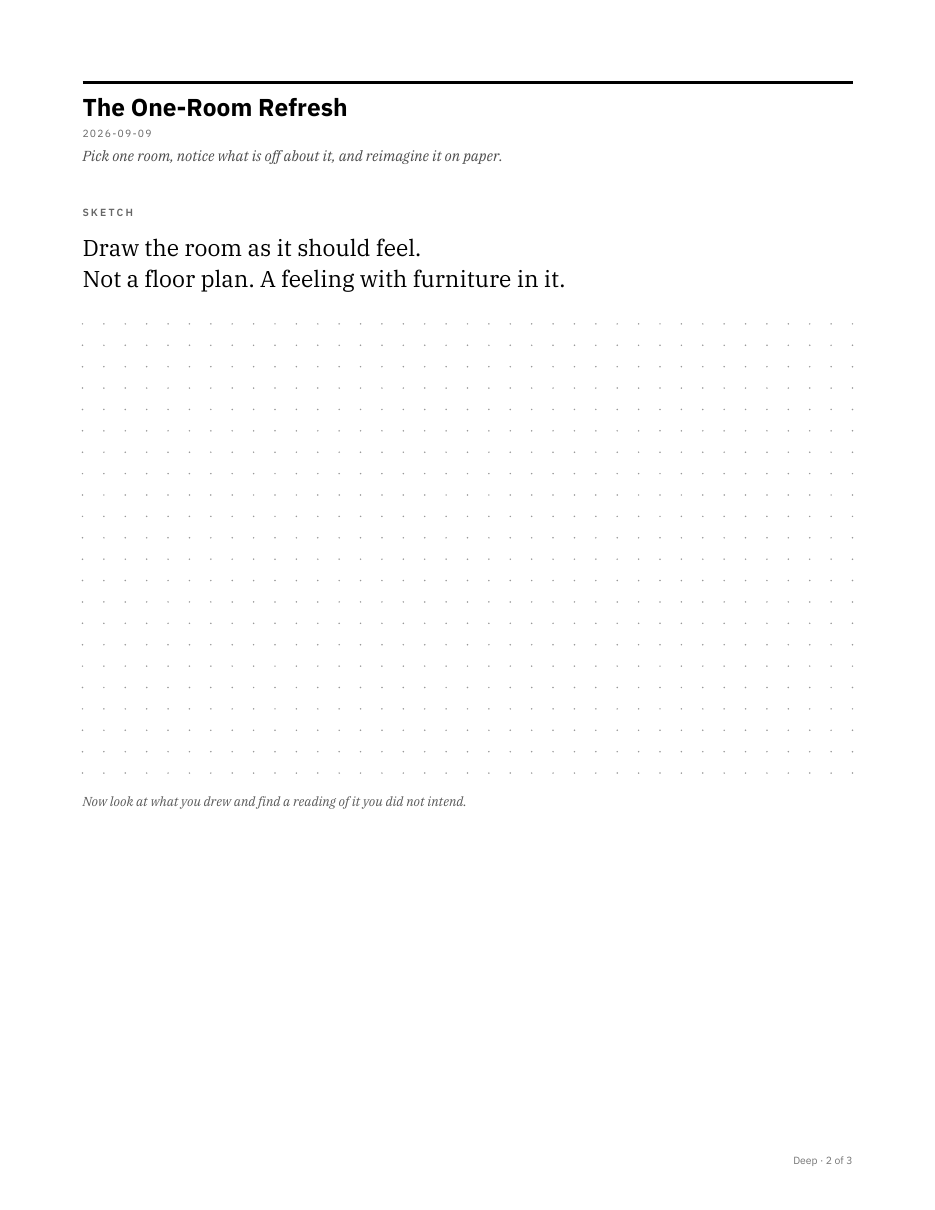
The One-Room Refresh opens with three free lines for the complaints you already had, so they are out of your head and off the table. Then it asks for twelve more, and at least two of them should be things you had stopped noticing. The page spends the cheap answers first, so the real ones have somewhere to land.
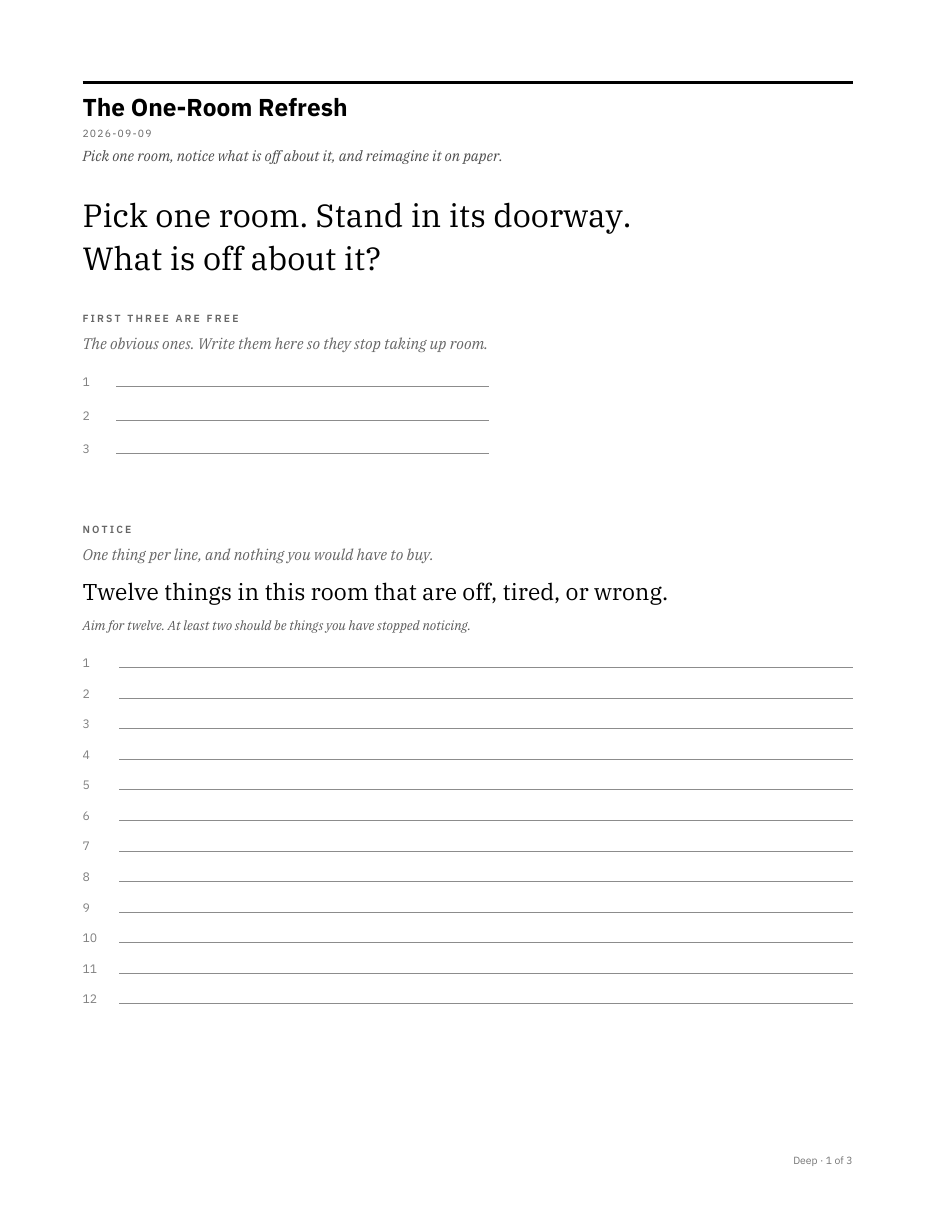
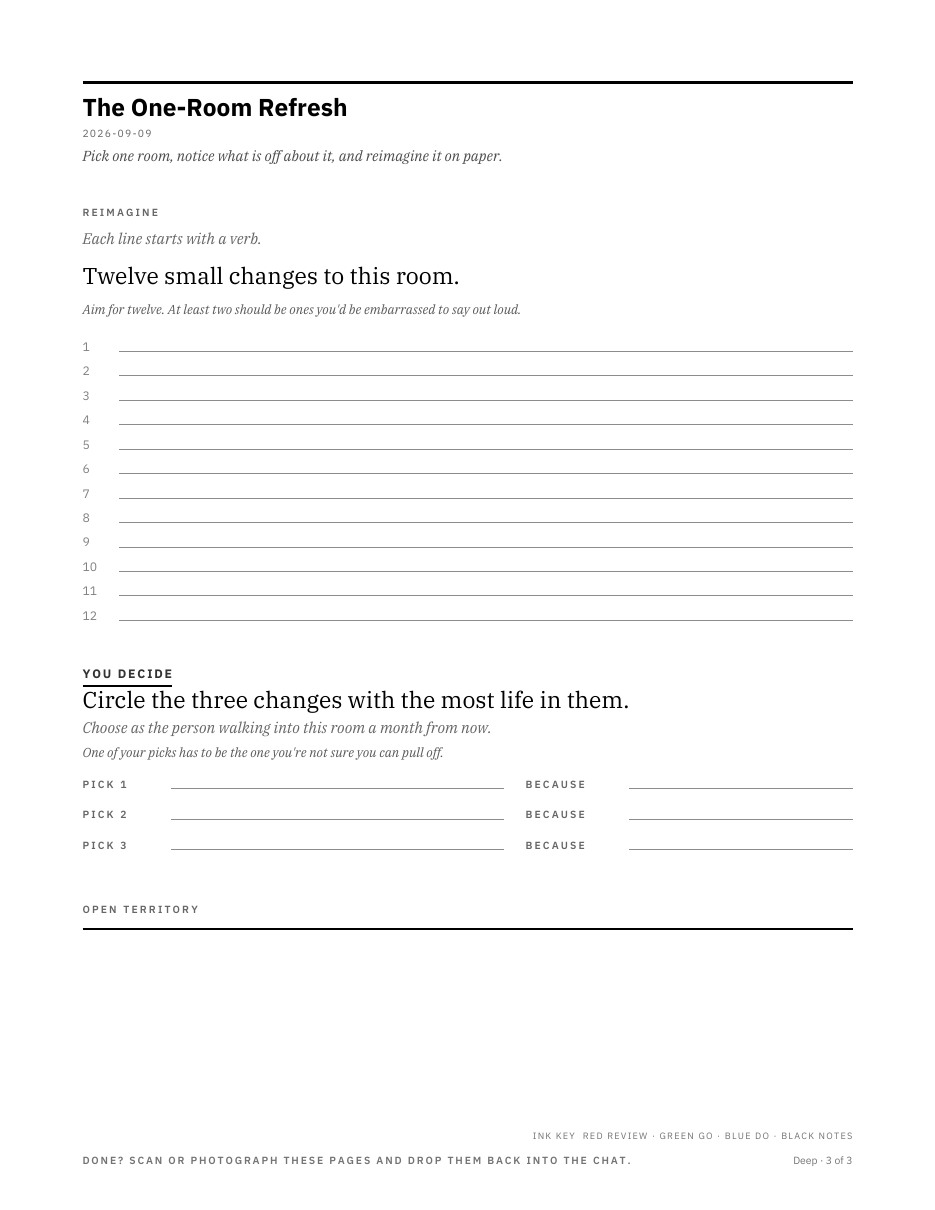
There is no QR code anywhere on the page.
No session ID, no tracking marks, nothing on the page addressed to a computer. The moment a sheet looks like a form for a scanner it stops feeling like yours. So it has one job, which is to be worth writing on, and a layout check fails the build if text collides.
The sheets come back with handwriting on them.
The Session Arc deep sheet for my fall course at VCU, filled in with a pen on a park bench. The re-sequence column is where the course got designed: taste as a skill first, the brief that resists third, field week fourth. My note in open territory says it plainly: feels like the right assignment. More ideas, more words. That is the thesis, photographed.
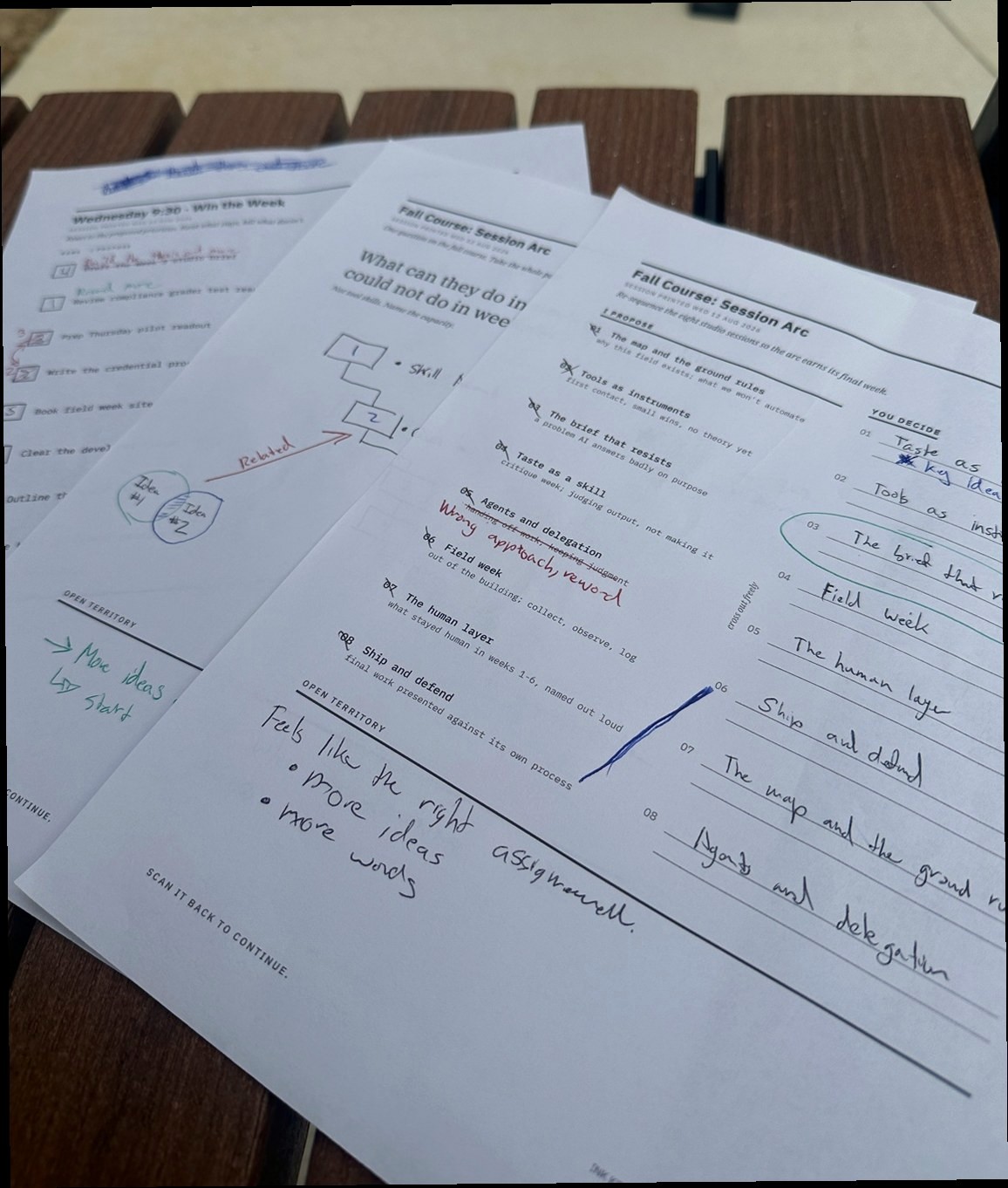
The second skill is scan-back. It reads my handwriting off the photograph and the work carries on as if it never paused.
There is one authority rule: where what I wrote contradicts what the model proposed, mine wins, silently and completely. Four ways in, a one-line install command, a packaged skill bundle, a single pasted file, and a dictated card for anyone with no printer at all.